
A Pair of Recent Rulings May Signal What the Future Looks Like for Short-term Rentals in Michigan
September 29th, 2025 | By: Matthew I. Paletz, Esq.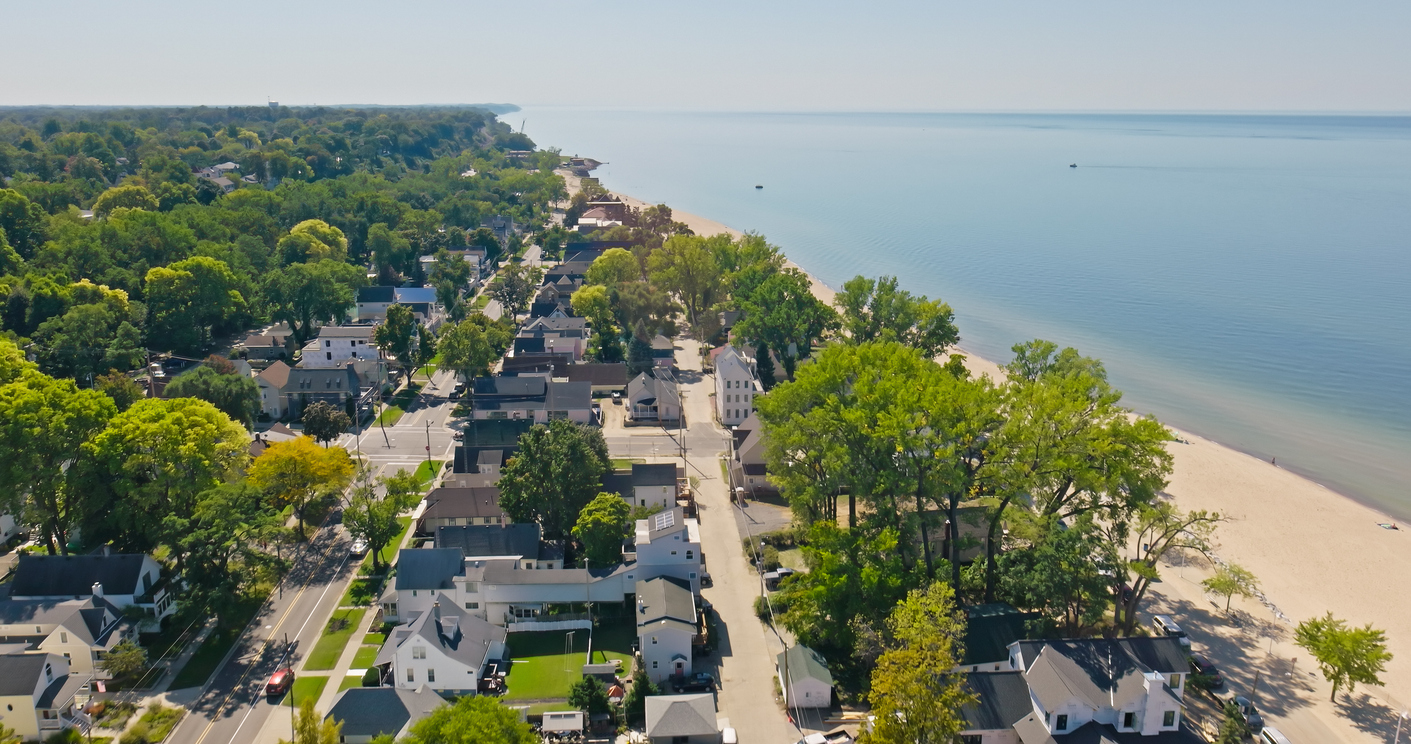 Aerial shot of St. Joseph, a city on the shores of Lake Michigan
 A Michigan Supreme Court decision and a vote by a local city council earlier this year have sent some chills through the short-term rental communities in Berrien County and Dearborn, respectively. These are examples of the growing tension between what some view as property rights and others’ need for the preservation of residential neighborhoods.
A Potential Precedent for Restrictive Covenants?
In Berrien County on Lake Michigan, the Swift Estates legal case began when Laura and Scott Malkin, along with Thomas Rubin and Nina Russell, purchased homes in a nine-home subdivision with the intention of operating them as seasonal vacation rentals. Between 2012 and 2020, their properties hosted at least 55 different renters, reportedly creating friction with permanent neighbors who complained about what they referred to as “large parties and property trespassing.”
According to the Detroit Legal News, the primary focus of the legal dispute centered on a 1977 neighborhood covenant restricting lots to “single-family residence purposes.” The Berrien Circuit Court and Court of Appeals both ruled that this language prohibited short-term rentals. However, the Michigan Supreme Court’s split decision showed the legal complexity of interpreting restrictions such as these. Justice Kimberly Thomas, writing for the dissent, argued the covenant was ambiguous and could be interpreted in multiple ways, emphasizing that “ambiguity argues in favor of the property owner having discretion.”
In Dearborn, the city council passed an ordinance that restricted the use of short-term Airbnb and Vrbo rentals to the east and west downtown districts.
“The problem with Airbnb is that you have people coming and going at different hours. You don’t know who they are. You don’t know who’s supposed to be there,” said one resident during the Dearborn public meeting. “Many of us who actually own short-term rentals actually live in these neighborhoods. I don’t accept the idea that we are somehow disrupting our own community’s environment,” said another resident during the meeting.
However, others in the meeting complained that the loss of extra income from the short-term rentals would have dire financial consequences for property owners. “Some of us make a living. Some of us pay our healthcare, bills, and taxes. So now they’re gonna cut off this income for us,” said Bruno Morabito.
Cities and Communities Put the Hammer Down on Short-Term Rentals
Michigan’s rulings are just a puddle in an ocean of a national NIMBY (Not in My Backyard) movement to regulate short-term rentals. Most prominently, New York City’s Multiple Dwelling Law prohibits renting out unhosted space for fewer than 30 days in buildings with three or more units, while California cities like Irvine and Temecula have completely banned Airbnb and Vrbo.
Some cities now allow Airbnb rentals only in specific neighborhoods, such as commercial zones, but not in residential ones, while others limit the number of short-term rentals in certain areas or even the distance between rentals on the same block. Cities such as Scottsdale, Arizona, require hosts to notify their neighbors of their intent to operate a short-term rental, adding another layer of bureaucracy to property use.
The Legal Argument
Some legal experts are viewing these restrictions as a taking of property. Legal scholar Jamila Jefferson-Jones of the University of Kansas Law School has examined whether short-term rental restrictions constitute an unconstitutional taking, arguing that such regulations may infringe upon fundamental property rights.
Likewise, other property rights advocates argue that these Airbnb restrictions are a blatant example of government overreach, undermining the entire concept of private property ownership. The argument is that if someone legally purchases a home, they should have the right to rent it out, whether for a year or a weekend, as long as they comply with basic safety and tax requirements.
However, there is also concern from other property owners about how being a neighbor to a short-term rental affects the use of their own homes.
Noise disturbances from excessive partying, loud voices, and constant activity (Airbnb Neighbor Complaints: How To Keep Neighbors Happy) top the list of grievances. Their argument is that short-term renters have no stake in the community, and therefore no reason to care how the neighborhood around them suffers from their vacation activities. This, detractors say, leads to a revolving door of strangers who treat residential areas like temporary playgrounds rather than established communities.
Property Owners Need to Exhibit Due Diligence
In an increasing number of cities, towns and communities, purchasing property no longer guarantees the right to use it as you choose, depending on your location.
The Michigan Supreme Court’s deadlock reflects a national legal debate over striking a suitable balance between property rights and community concerns. As more cities implement restrictive regulations, property owners are facing a complex web of rules that make short-term rentals an increasingly difficult proposition.
It is becoming increasingly apparent that any private property purchase intended for short-term rental income should include a thorough review of all city and HOA covenants related to this practice. If you have any questions about the use of your rental property, please contact Paletz Law.
Speak with a Paletz Landlord
Advocate Today